The history of the Gran Premio Liberazione is both long and recent at the same time: long because the race was born in 1946 precisely out of the desire to celebrate, through the unifying spirit of sport, the day that marked Italy’s exit from the world conflict. Recent because the event had gradually fallen into crisis until it disappeared from the calendars. A slow but inexhaustible decline that the Lazio Region faced alongside the former organizers, trying in every way to stop it, but also strongly supporting the acquisition of the rights by the new staff led by Claudio Terenzi. On these grounds, the conversation with Roberto Tavani, Sports Delegate of the Lazio Region, soon and completely diverges from the usual interviews with the politician of the moment about the event of the moment. Real issues are discussed, always linked to the event of April 25th: “The body to which I belong has always shown great interest in the Gran Premio Liberazione, supporting it as long as possible when it was in serious difficulty precisely because of the meanings and prestige that the event has always shown. All the more reason we are present now that new potential is emerging strongly. We are talking about the third oldest sporting event in the Capital after the equestrian competition and the Internazionali d’Italia, but beyond the sporting aspect, it is the intrinsic meanings of the event that remain indelible and put it in the foreground even in our eyes. Just remember what happened in the first post-war editions, when the winner would then go with a wreath of flowers to Porta San Paolo to pay homage to the fallen. The Liberazione has the undeniable merit of passing on memory through sport, which is no small thing.” The Gran Premio Liberazione is changing its skin. Under the vigorous leadership of Team Terenzi, many new initiatives are springing up around the international Under 23 event, such as the Saturday bike ride that will kick off the three-day Roman cycling event. It is precisely on this novelty that Tavani wants to place emphasis, also to break out of the rigid schemes of competition: “In this way, the theme of cycling is joined by that of bikeability. An event like the Liberazione for competitors makes you want to ride, but as with every top-level sport, it remains something you watch, with popular participation remaining external. In this way, however, you can be a protagonist, the bike ride becomes an element of promoting cycling in the city and thus enriches the fabric of the Liberazione with new themes, alongside the value of memory and the past, that of life in the present, environmental sustainability in a metropolis, the importance of road maintenance that makes circulation possible and less dangerous for those who do not use motorized vehicles.” The occasion is a good one to submit an important issue to the representative of the Body: in Rome as in Lazio there are many running events, ranging from the international level to neighborhood races. Cyclistically, the annual calendar is much, much leaner; could the Liberazione, as a flagship event, be a driving force for expanding the panorama of two-wheel events? “The issue is interesting and must be addressed delicately. The running movement has established itself over the years, but we must not forget that until a couple of years ago it risked a strong contraction that could have led to a crisis with no return. The issue of road races as a whole is difficult, I am convinced that their future (and I am talking about running as well as cycling) can only pass through a moratorium on management costs, from police to barriers. Very high costs, which for cycling races, by their very nature, are even higher. Potentially, it is clear that as with running, cycling could also have events, spaces, opportunities, but we must consider the costs that have no guarantees. Team Terenzi deserves praise for taking on a considerable burden, returning a heritage to the city.” In this regard, it should not be forgotten that the Liberazione restarted after two years of stoppage and those who gravitate in the sports world know well that relaunching an event after such an interval is very difficult because it is easy to forget: “We too in the Region at a certain point were giving up, considering the enormous costs of the event and we no longer believed that anyone could embark on this arduous adventure. Restarting is very complicated even though the Lazio cycling movement is more alive than ever. Having succeeded is a relief, now Team Terenzi needs everyone’s support, to bring the Liberazione back to its former glory but in step with third millennium cycling.”
© Gran Premio Liberazione. SSD Terenzi Sport Eventi
© Gran Premio Liberazione. SSD Terenzi Sport Eventi


GP Liberation and Lazio Region: an uncommon combination
GP Liberation and Lazio Region: an uncommon combination
2022-01-14 13:25
Array() no author 87360
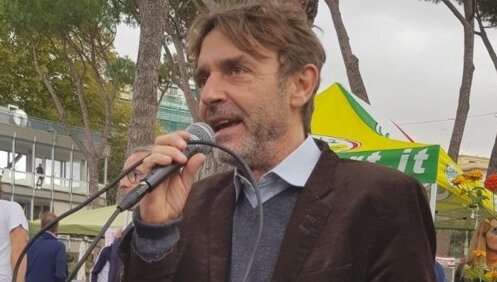
For Roberto Tavani, sports delegate of the Lazio Region, cycling and running rightly need the utmost support. "The Liberazione passes on the
© Gran Premio Liberazione. SSD Terenzi Sport Eventi