For over forty years Tonino Giuliani has been the “eye” of the Gran Premio Liberazione. His presence is fundamental, in fact one could say that without him the Liberazione would lose much of its spirit. In front of his lens (and we emphasize that Giuliani is not a professional photographer) the Roman race has evolved, has crossed decades even changing hands, yet his experience was born almost by chance: “I went to see the Liberazione in ’79, my brother who worked at Unità told me they needed help for the photographer at the time, for advertising and awards, so I started and never stopped.” His photographic archive is vast, moreover when the Primavera Ciclistica closed its doors, Giuliani kept all the prints, effectively saving what is a real heritage to be digitized little by little. Like the archive, the reservoir of memories is also rich: “They are all linked to the Liberazione in conjunction with the Giro delle Regioni because for so many years we raced in Rome and then immediately left for the prologue of the stage race which already took place in the afternoon. It was for national teams and thanks to the inventiveness of Eugenio Bomboni we really traveled around Italy living unique experiences, like the arrival of the bikes in Piazza del Campo in Siena experiencing the life of the contrade the night before, or the start from inside the Abbey of Casamari.” Giuliani remains deeply attached to Bomboni: “He was a volcano of ideas. I won’t hide it, he was the glue that kept me tied to the Liberazione, he was a unique character, like you don’t find anymore. When he stepped aside the Liberazione quickly declined, I must say that now under Terenzi’s leadership it is recovering precisely because he has a bit of the same adventurous spirit.” Many champions have been immortalized by Giuliani’s lens: “It’s clear that my heart is tied to Gianni Bugno, the one in Rome was the first of many highlights in the career of an absolute champion, but even then you could see his crystalline class because he was very fast. Then I remained fond of the Liberazione during the presence of the Eastern European teams when the big teams from the DDR and the USSR arrived and won everything. I remember, for example, the Russian coach Kapitonov, who had won the Olympics in Rome: he was very attentive and also prey to small fixations. His riders had the habit of attaching the race route map to the handlebars, he would insist when I took photos that they put their hand over it, so as not to show what was written... Then I remember the great Soukhorucenkov, who never won the Liberazione, but was really seen as if he were Merckx.” In his history Giuliani has also witnessed epochal changes in the race, such as the advent of the current circuit: “We got there gradually. I remember once the Liberazione was designed as a road race that touched Maccarese and Ladispoli, or when, in anticipation of the possible organization of the Olympics in Rome, Bomboni experimented with a larger circuit, exceeding 10 km and even touching the Colosseum. But it created too many problems, with traffic jams and the difficulty of crossing the tram tracks. Then it was understood that the Liberazione must not change from its tradition, the current circuit is the right one.”
© Gran Premio Liberazione. SSD Terenzi Sport Eventi
© Gran Premio Liberazione. SSD Terenzi Sport Eventi


The story of the Liberation through the "eyes" of the photographer
The story of the Liberation through the "eyes" of the photographer
2022-03-18 12:22
Array() no author 87360
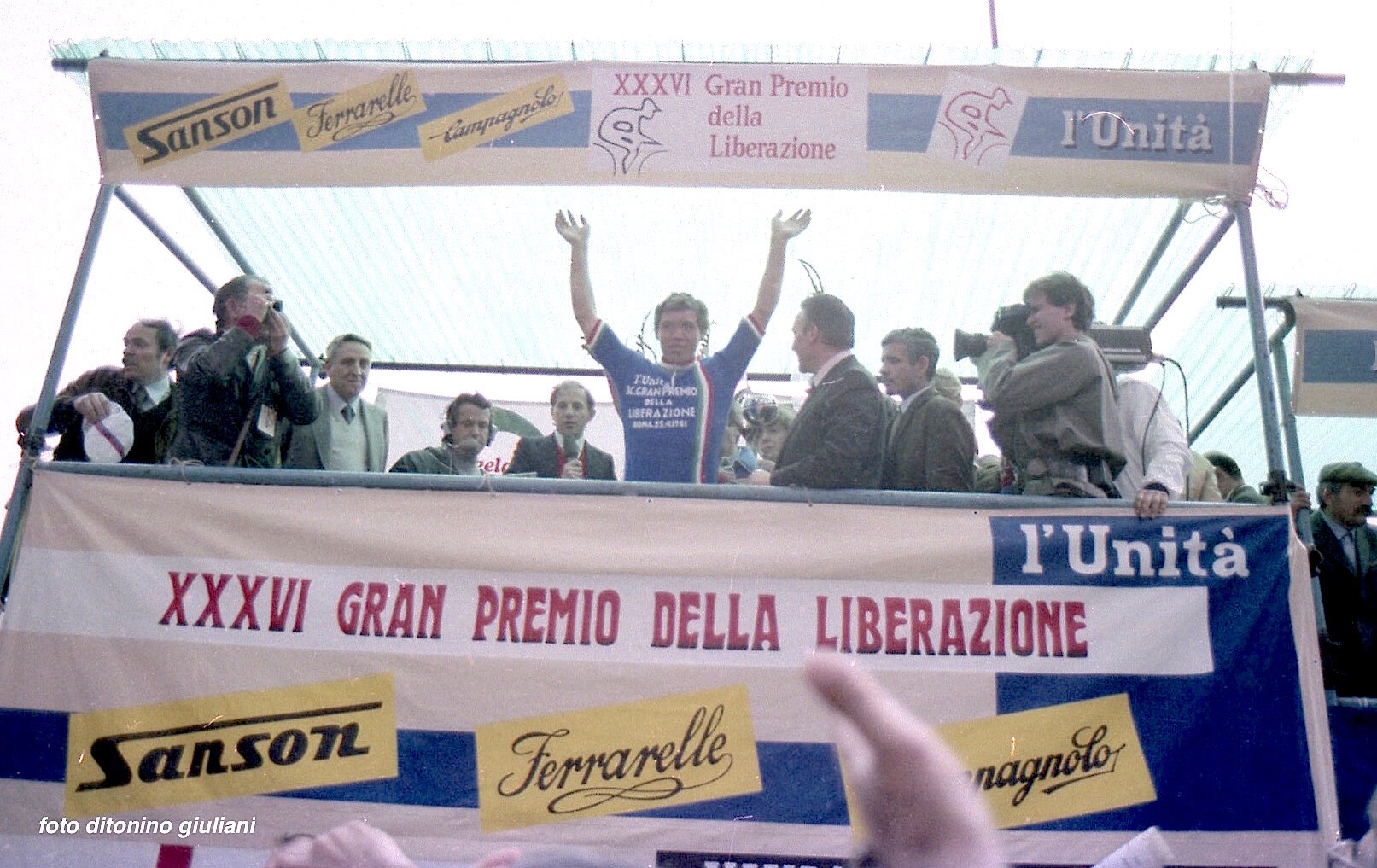
For over forty years Tonino Giuliani has been the photographer par excellence of cycling. "So many wonderful memories tie me to the Liberazione: Eugenio Bomboni, the an
© Gran Premio Liberazione. SSD Terenzi Sport Eventi